
Welcome. I’m Dr. Laura Catena, a Harvard and Stanford-educated physician and fourth-generation vintner. My perspective on wine and health has evolved alongside scientific research. Today, we find ourselves at a point of equipoise, where light to moderate alcohol consumption, presents both benefits and risks. As UCSF cardiologist Dr. Greg Marcus says, “The evidence for health and harm is fairly equal.”
While heavy drinking is undeniably harmful, studies on the Mediterranean Diet, which includes moderate wine consumption, indicate potential reductions in heart disease, dementia, and cancer risks. For people over 40, moderate drinking may offer cardiovascular benefits, as noted in The Lancet (2022).
Personally, I enjoy a glass of wine a few times a week, often with family dinners or friends. For me, the heart benefits outweigh the slight cancer risk—a decision made in consultation with my doctor.
I encourage you to consult your physician to make informed health and lifestyle choices. Thank you for visiting—I hope you find this information-packed exploration of the science behind wine, alcohol and health useful.
Watch and download the Presentation
Dr. Laura Catena is a physician and 4th generation vintner, graduated from Stanford Medical School (Class of 1992), who practiced as an Emergency Physician in California for 27 years.
Read this article on SevenFifty Daily, to understand the nuances of the current alcohol and health debate.
SevenFifty Daily, “What the Headlines Get Wrong About Alcohol and Health“
By Dr. Laura Catena. November 11, 2024.
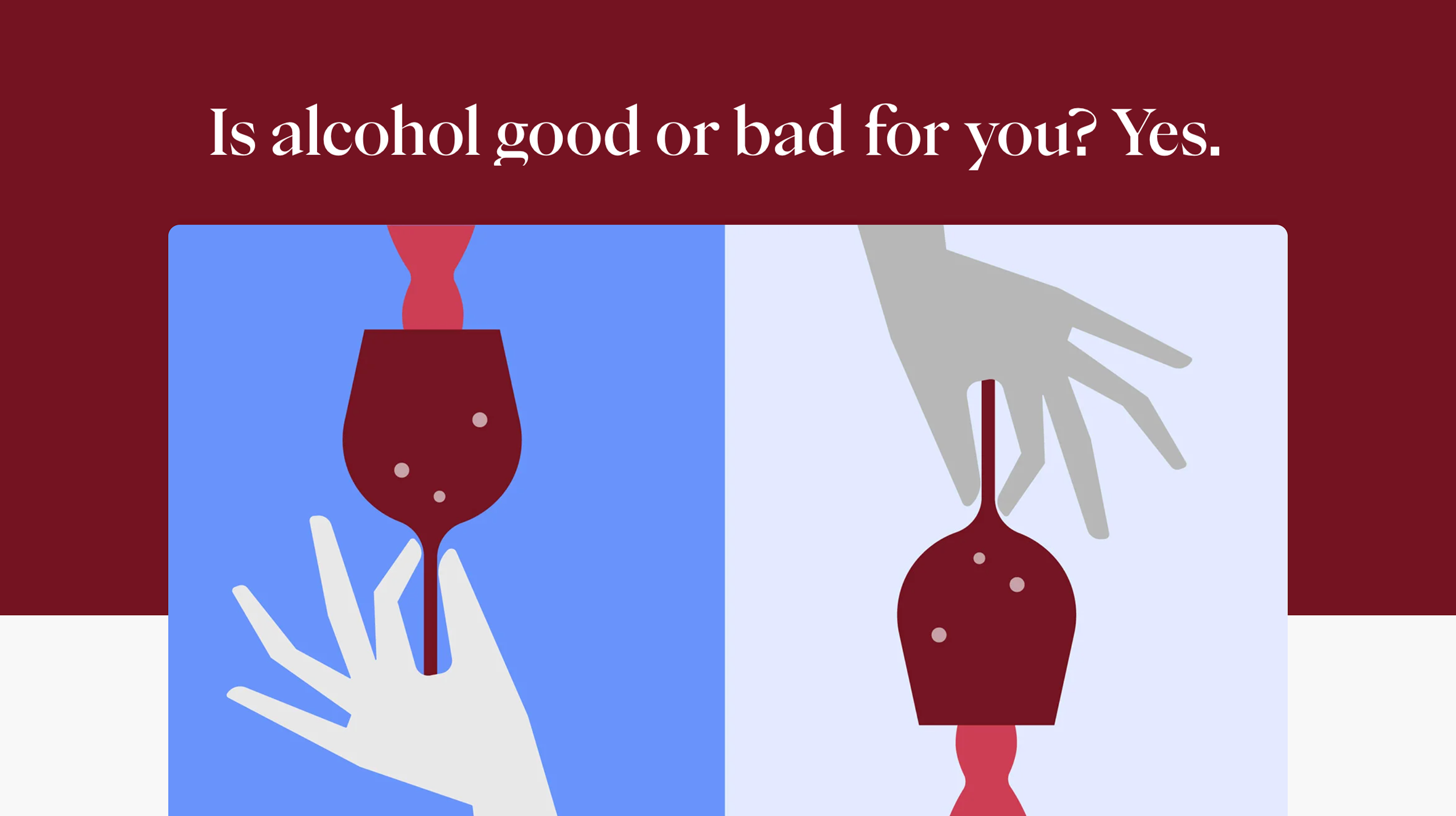
Read this article to understand the nuances of the current alcohol and health debate.
Harvard Public Health, “Is alcohol good or bad for you? Yes.”
By Kenneth Mukamal and Eric B. Rimm. August 2022.
Dr. Laura Catena’s
Responses to the Media
-
Wall Street Journal :: Your Happy Hour Habits Could Raise Your Cancer Risk
Read more: Wall Street Journal :: Your Happy Hour Habits Could Raise Your Cancer Risk“Your Happy Hour Habits Could Raise Your Cancer Risk” February 11, 2025, by Sumathi Reddy Dr. Catena’s Response: Sumathi Reddy’s article, Your Happy Hour Habits Could Raise Your Cancer Risk, mistakenly equates all alcohol drinking with smoking. This comparison is flawed. Moderate alcohol consumption—up to one drink per day for women and two for men—has been associated with cardiovascular benefits. Tobacco increases cardiovascular risk even at low consumption levels. A recent peer-reviewed report by the U.S. National Academy of Sciences, Engineering, and Medicine (NASEM) found that moderate drinkers lived longer and had fewer cardiovascular deaths than never drinkers. The potential biological mechanism for this:…
-
The New York Times :: “The Battle Over What to Tell Americans About Drinking”
Read more: The New York Times :: “The Battle Over What to Tell Americans About Drinking”“The Battle Over What to Tell Americans About Drinking” January 1st, 2025, by Roni Caryn Rabin Dr. Catena’s Response: The New York Times’ War on Moderate Alcohol Consumption The latest salvo in the New York Times’ war on moderate alcohol consumption came New Year’s Day, with The Battle Over What to Tell Americans About Drinking by reporter Roni Caryn Rabin. The New York Times didn’t cover the release of the report on alcohol and health when it was first issued on December 17, 2024, by the National Academies of Sciences, Engineering & Medicine (NASEM). To cover the NASEM report as news would…
-
National Academies Science Engineering Medicine :: “Review of Evidence on Alcohol and Health”
Read more: National Academies Science Engineering Medicine :: “Review of Evidence on Alcohol and Health”National Academies Science Engineering Medicine December 17, 2024 Dr. Catena’s Response: I’m Dr. Laura Catena, a Harvard and Stanford-educated physician and fourth-generation vintner. A committee of the U.S. National Academies of Science, Engineering and Medicine, or NASEM, has issued a new report, “Review of Evidence on Alcohol and Health.” These are my immediate takeaways from a first review of the report: The NASEM report experts were mindful to eliminate any “abstainer bias” from their report by requiring the “never drinkers” control group to not include any former drinkers who might have been less healthy due to prior alcohol use disorder.…
-
The Wall Street Journal :: “Do Americans Drink Too Much? Alcohol Is Driving a Debate in Washington”
Read more: The Wall Street Journal :: “Do Americans Drink Too Much? Alcohol Is Driving a Debate in Washington”“Do Americans Drink Too Much? Alcohol Is Driving a Debate in Washington” June 24, 2024, by Kristina Peterson and Julie Wernau. Dr. Catena’s Response: As a physician who practiced emergency medicine in California for 25 years, I am surprised to read that the USA panel on dietary recommendations concerning alcohol does not include the United States’ leading researchers on the topic, and instead includes a Canadian researcher and a WHO official. Hundreds of studies have shown a correlation between moderate alcohol consumption and cardiovascular benefits. The Wall Street Journal article states that some of these articles have been questioned, and…
-
The New York Times :: “Older Adults Do Not Benefit From Moderate Drinking, Large Study Finds”
Read more: The New York Times :: “Older Adults Do Not Benefit From Moderate Drinking, Large Study Finds”“Older Adults Do Not Benefit From Moderate Drinking, Large Study Finds” August 12, 2024, by Roni Caryn Rabin. Dr. Catena’s Response: Following is an exclusive response from Dr. Laura Catena to the Editor RE “Older Adults Do Not Benefit From Moderate Drinking, Large Study Finds”. The article “Older Adults Do Not Benefit from Moderate Drinking” misinforms the public. The referenced August 12th JAMA Network study by Dr. Ortolá et al. actually finds that people defined as healthy (using UK Biobank’s Frailty Index) were not harmed by drinking moderately, in fact healthy adults over 60 were found to have no statistically significant increase…
-
Vancouver Sun :: “For Gen Z and Millennials, it’s cool to be sober”
Read more: Vancouver Sun :: “For Gen Z and Millennials, it’s cool to be sober”“For Gen Z and Millennials, it’s cool to be sober” July 23, 2024, by Denise Ryan. Dr. Catena’s Response: In the interest of scientific accuracy, Dr. Catena would like to shed light on these points referenced in your article. A magna cum laude graduate of Harvard University and Stanford University Medical School, Dr. Catena practiced emergency medicine in San Francisco for over twenty-five years. She is also the Managing Director of a family winery in Argentina. Dr. Catena has extensively reviewed the literature on wine and health. Your article references this paper published by Dr. Tim Stockwell of the Canadian Institute for…
-
The New York Times :: “For Gen Z and Millennials, it’s cool to be sober”
Read more: The New York Times :: “For Gen Z and Millennials, it’s cool to be sober”“Deep Links Between Alcohol and Cancer Are Described in New Report“ September 18, 2024, by Roni Caryn Rabin. Dr. Catena’s Response: The recent New York Times article, “Deep Links Between Alcohol and Cancer Are Described in New Report,” presents a complex issue in a manner that may lead to some misunderstanding. While the article raises important points about alcohol consumption and health risks, it appears to conflate information about light to moderate drinking with data on general alcohol consumption. As both a physician and a vintner, I believe it’s crucial to provide a balanced perspective that accurately informs the public…
Watch, Read, Listen
WineBusiness.com
Public Comment about ICCPUD committee for underage drinking advisory for DGA alcohol guidelines
July 29, 2024, by Laura Catena, M.D.
HDSR: The Harvard Data Science Review
Episode 43. How Many Glasses of Wine a Day Keeps the Doctor Away?
Listen on: Podbean | Apple | Spotify | Amazon Music | Audible
July 30, 2024, by Laura Catena and Ahmed Tawakol.
WineSearcher.com
Congress Questions Origins of Alcohol Panel
Why are openly anti-alcohol activists being allowed to influence US alcohol policy? We’re not the only ones asking.
July 25, 2024, by W. Blake Gray.

 In Defense of Wine